


Organic Fertilizer Pulverizer | Chicken Manure Crushing Machine
Published on: 2026-01-20In the journey from raw waste to packaged organic fertilizer, pulverizing is the transformative first act. A well-designed fertilizer powder making plant hinges on its crushing stage, where raw, heterogeneous materials are converted into a uniform substrate. This process is crucial whether you are producing chicken manure fertilizer powder for direct bagging or preparing material for granulation in a bio-organic fertilizer production line. This article explores how specialized fertilizer crusher machines, like the Semi-Wet Material Crusher and Vertical Chain Crusher, serve as the indispensable workhorses that enable efficient and high-quality organic fertilizer production.
The "Why": Critical Objectives of Fertilizer Crushing
Crushing is far more than just making materials smaller. It serves several vital functions:
Surface Area Increase: Breaking down particles exponentially increases their surface area, which is essential for effective microbial activity during fermentation (for organic fertilizer) and for chemical reactions in compound fertilizer processing.
Homogenization: It creates a consistent particle size distribution, ensuring uniform nutrient content in every bag. This is non-negotiable for product quality and consumer trust.
Granulation Preparedness: For organic compound fertilizer grinding, a uniform and optimally sized powder is mandatory. It allows for better binding, smoother pellet formation in the granulator, and stronger final granules.
Moisture & Aeration: Crushing helps regulate moisture distribution and improves pile aeration during composting, accelerating the manure processing cycle.
Application Spotlight: Crushers in Action
Different stages and materials demand specific crushing solutions.
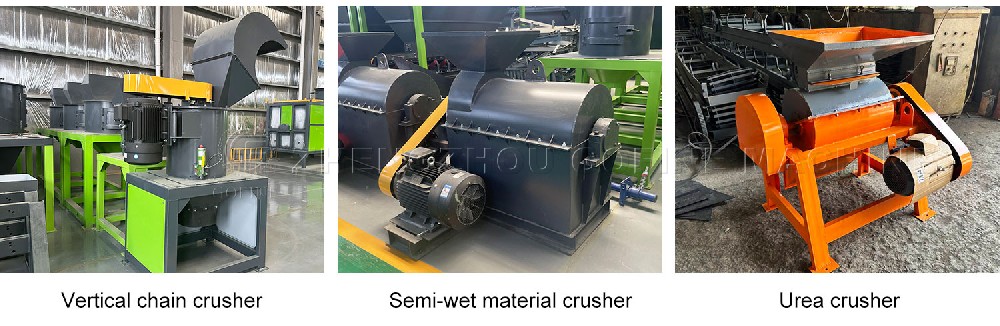
Pre-Compost Processing with a Semi-Wet Material Crusher
For operations starting with fresh or partially composted manure, the initial breakdown is key.
Challenge: Hardened chunks of cow dung or chicken manure are difficult to compost evenly.
Solution: A Semi-Wet Material Crusher can process this high-moisture content material. It breaks apart clumps, creating a more uniform pile structure that composts faster and more completely, forming the perfect raw material for an organic fertilizer production line.
Post-Compost & Powder Production with Chain & Hammer Crushers
Once compost is mature and dried, it needs to be refined into a saleable product.
For Powder Fertilizer: A Vertical Chain Crusher or a High-Speed Hammer Crusher takes the dry, composted material and pulverizes it into a fine, consistent chicken manure fertilizer powder or cow dung powder, ready for screening and packaging.
For Granulation Feedstock: The same machines ensure the composted powder is fine enough for optimal binding in a pelletizer, a critical step in bio-organic fertilizer production.
Raw Material Preparation in Compound Fertilizer Plants
Inorganic fertilizer production also relies heavily on crushing.
Application: Urea crusher and NPK crusher units are used to break down caked or oversized granules of raw materials like urea, ammonium chloride, or potassium chloride before precise weighing and mixing.
Equipment: Cage crushers or specialized hammer mill crushing machines are often used here for their ability to crush crystalline materials to a desired size without excessive dust.
Conclusion: The Foundation of Consistency
The choice and operation of your fertilizer crushing machine set the tone for everything that follows in your powder fertilizer making machine line. By selecting the right technology—such as a robust Semi-Wet Material Crusher for moist compost or an efficient chain crusher equipment for dry materials—you solve the fundamental challenge of raw material inconsistency. This investment lays a solid foundation for a production process that is efficient, scalable, and capable of producing a high-quality, market-ready organic fertilizer product that stands out for its reliability and performance.
